Investment Research
How an idea becomes an investment thesis: research companies, examine assumptions, and learn to distinguish a strong argument from an unsupported opinion.
Join Us
The Finance Program · First cohort 2026
A small offshoot of the institute, for Cathedral Catholic students who want one lane only: finance, investing, and markets — 25 students, a smaller classroom, and a year that ends with you defending an investment thesis to professionals.
Want the full suite — every function of a business, the Case Competition, and a company of your own on the Summit stage? That’s the Flagship Program. This page is the smaller start: finance only.
The classroom
The Flagship sweeps through every function of a business. This room does the opposite — 25 students, one subject, all year. Every session runs the same five-part discipline:
The goal is not to learn financial terminology. It is to start thinking like someone who works in finance.
Semester one
Three sessions and a rehearsal — that’s the whole fall. Small on purpose: one lane, walked slowly enough to actually learn it.
Session 01 · Tue, Sep 29 · 2:30–4:15 PM
Finance starts with understanding money itself — saving, investing, compounding, risk, and the principles behind long-term wealth.
Session 02 · Wed, Oct 21 · 2:30–4:15 PM
Why does one investment rise while another falls? How markets operate, and how investors evaluate risk, return, and information over instinct.
Session 03 · Tue, Nov 17 · 2:30–4:15 PM
Move from the investor’s perspective inside the company: raising capital, evaluating investments, allocating resources, analyzing performance.
Rehearsal · Wed, Nov 18 · 2:30–4:30 PM
A dedicated session to rehearse, receive feedback, refine your reasoning, and prepare for the capstone — turning financial knowledge into confident communication.
Semester one capstone · Friday, December 4
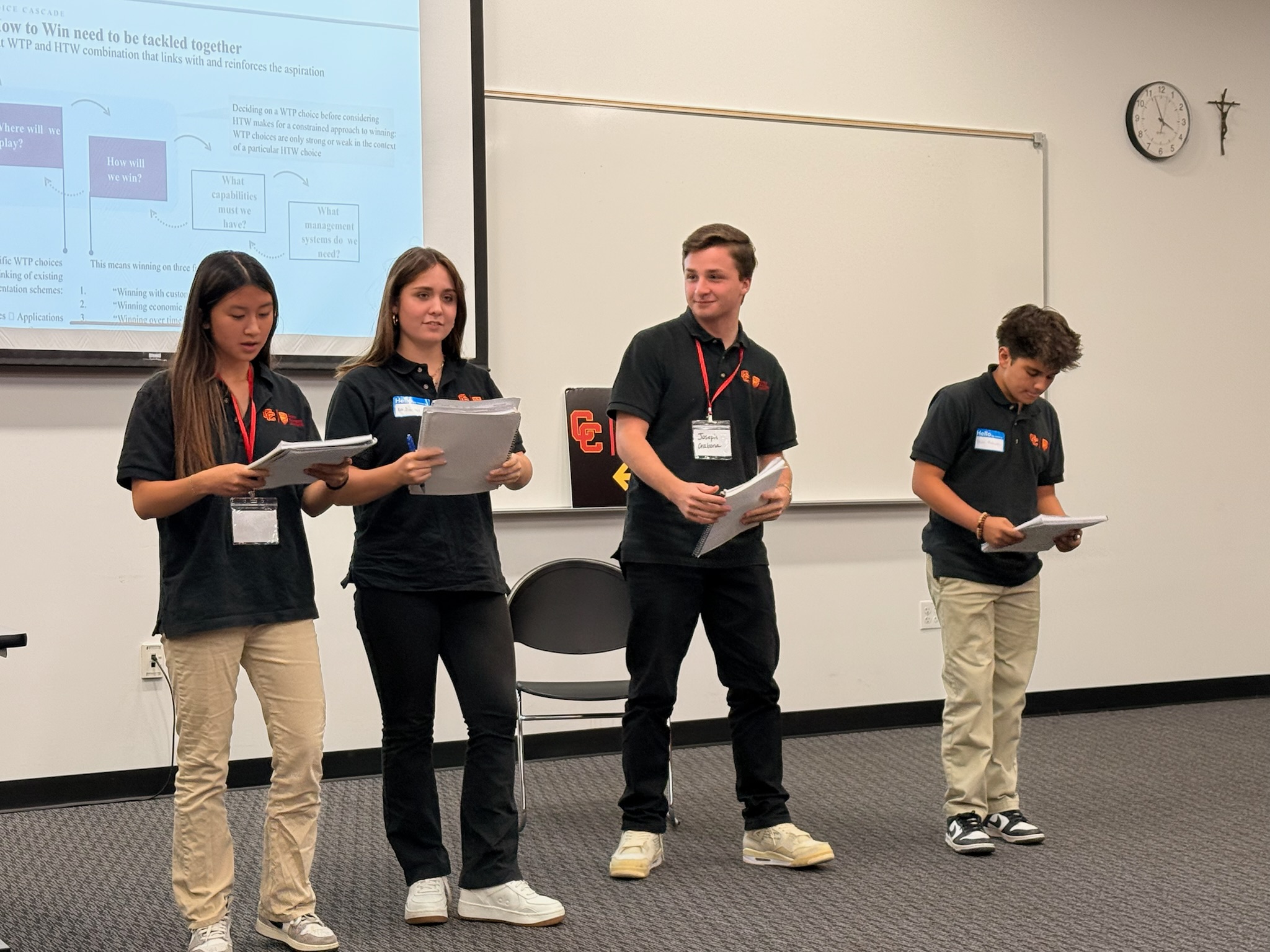
The first semester ends differently than it began. Instead of learning in the classroom, Finance Division students become the teachers — designing and running financial-literacy activities for younger students from Catholic elementary schools.
They must take concepts that seem complicated and make them understandable, practical, and engaging. All 25 participate.
Because one of the best tests of whether you understand something is whether you can teach it to someone else.
Semester two
The lane stays narrow; the work gets real. Students stop asking “how does finance work?” and start asking “what would I do with this information?”
How an idea becomes an investment thesis: research companies, examine assumptions, and learn to distinguish a strong argument from an unsupported opinion.
AI is changing how financial information is researched and used. The question that matters: what should technology calculate — and where does human judgment still rule?
Bring the research together into a clear recommendation: what the company does, why the opportunity exists, how it’s valued, what could go wrong — and why your conclusion holds.
The final challenge
Research a publicly traded company. Develop an investment thesis. Present your recommendation to professionals with experience evaluating investments — and answer their questions about every assumption behind your analysis.
This is not a presentation about a company. It is a recommendation — made in a small room, to a table of professionals, with no stage and no prize pool to hide behind. By the end, the question is no longer do you understand finance?
Would you put money behind your own analysis?
Is it for you?
You do not need investing experience, or to know how to value a company. But you should already have a genuine interest in finance — investing, markets, wealth management, investment banking, corporate finance, fintech, economics — and want to go significantly deeper into it.
This is deliberately the smaller path — 25 seats, one lane, no venture term. Want the full suite of business? That’s the Flagship Program.
Where to next